

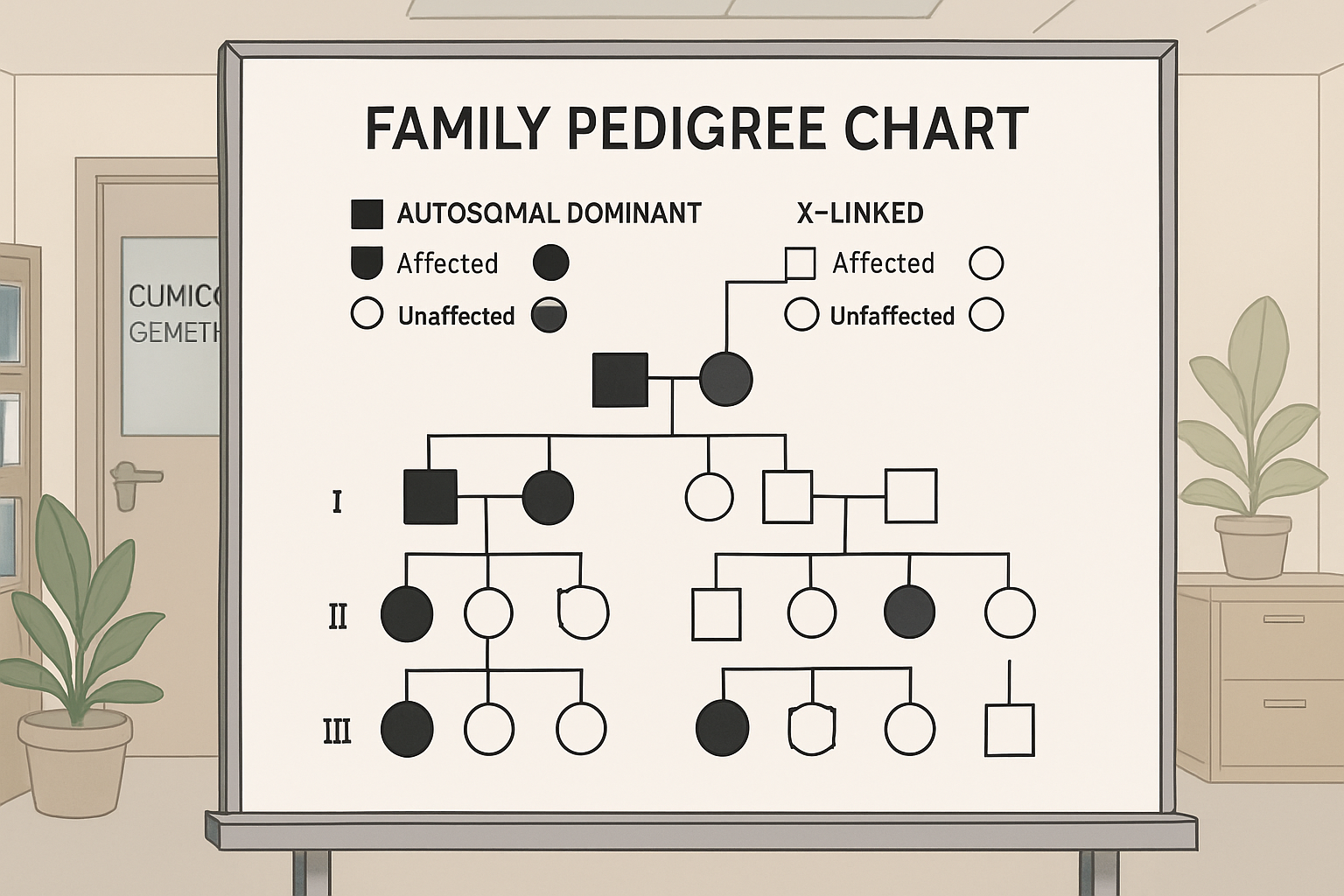
Introduction to Modes of Inheritance
Understanding modes of inheritance is crucial for clinicians and medical exam candidates, especially when interpreting genetic conditions in patients or answering exam questions. This guide offers a concise and practical overview of the four primary inheritance patterns: autosomal dominant, autosomal recessive, X-linked dominant, and X-linked recessive. Each mode will be broken down into key features, clinical examples, inheritance mechanics, and high-yield points, ensuring clarity and retention.
Grasping these modes not only aids in accurate diagnosis but also facilitates appropriate genetic counseling, risk assessment, and management strategies. Clinicians must be adept at recognizing inheritance patterns to predict disease recurrence risk and to counsel families effectively.
Moreover, understanding the nuances of inheritance patterns enables physicians to integrate family history with clinical findings, leading to better personalized care. This knowledge provides a foundation for interpreting genetic testing results, a growing component of modern diagnostics.
Autosomal Dominant Inheritance
Definition and Basics: Autosomal dominant (AD) disorders arise from mutations in a single allele of a gene located on one of the 22 autosomes. The presence of one mutated allele is sufficient to express the disease phenotype.
Key Features:
- Vertical transmission: Disease manifests in successive generations.
- Equal sex distribution: Both males and females equally affected.
- 50% transmission risk: Each child has a half chance of inheriting the mutant allele from an affected parent.
- No carrier state: Heterozygous individuals typically express the phenotype.
- Variable expressivity and incomplete penetrance: Severity and symptom presence can vary even within a family.
Examples: Huntington’s disease, Marfan syndrome, familial hypercholesterolemia, neurofibromatosis type 1.
Clinical Tips: On pedigree analysis, expect affected individuals in every generation, but be alert to incomplete penetrance where some carriers appear asymptomatic. Phenotypic variation might cause differential severity or symptomology among family members. Mutations often cause gain-of-function, dominant-negative effects, or haploinsufficiency.
Additional Considerations: New mutations are also common in some AD disorders, such as achondroplasia, resulting in sporadic disease without family history. AD disorders generally exhibit late onset compared to recessive disorders, which can be relevant clinically.
It is also important to recognize that certain AD disorders may affect multiple organ systems, and subtle signs in the physical examination can provide critical diagnostic clues. Using radiological, laboratory, or genetic testing can aid in confirming the diagnosis and stratifying disease severity.
Autosomal Recessive Inheritance
Definition and Basics: Autosomal recessive (AR) disorders require biallelic mutations for phenotypic expression. Individuals with a single mutated allele are carriers and typically asymptomatic.
Key Features:
- Horizontal transmission: Disease often appears among siblings with unaffected parents.
- Equal sex affectation: Males and females equally susceptible.
- Carrier parents: Usually healthy heterozygotes transmit the allele silently.
- 25% risk: Each child of carrier parents has one in four chance to be affected.
- Consanguinity: Increases risk, especially in isolated or consanguineous populations.
Examples: Cystic fibrosis, sickle cell anemia, phenylketonuria, Tay-Sachs disease.
Clinical Tips: Suspect AR inheritance when multiple siblings are affected without parental disease history. Biochemical or neonatal screening may assist early diagnosis. Carriers may have mild or no symptoms, underscoring the importance of family history. Molecular testing often confirms diagnosis.
Additional Considerations: AR disorders tend to present earlier in life and often have enzyme deficiencies or metabolic derangements. Genetic counseling focuses on carrier detection and counseling couples regarding reproductive options.
Carriers in many AR conditions may show biochemical abnormalities without clinical symptoms, which can be relevant in screening programs. Early diagnosis through newborn screening facilitates timely intervention that can prevent irreversible damage, as seen in phenylketonuria.
X-Linked Dominant Inheritance
Definition and Basics: Result from mutations in genes on the X chromosome, where a single copy can cause disease in both males and females, though severity and clinical manifestations vary.
Key Features:
- Transmission: Affected males transmit the mutant allele to all daughters but no sons.
- Variable expression in females: Due to random X-inactivation, females show a spectrum of severity.
- Both sexes affected: Males typically exhibit more severe phenotypes.
- Lethality in males: Some mutations lethal in hemizygous males, leading to female-predominant disease.
Examples: Rett syndrome, vitamin D resistant rickets (hypophosphatemic rickets).
Clinical Tips: Affected males passing disease exclusively to daughters signals X-linked dominant inheritance. Look out for female heterozygotes with variable expressivity. Recognize the importance of early diagnosis as some disorders require prompt management.
Additional Considerations: Disorders may show male lethality in utero, resulting in reduced male births. X-linked dominant conditions are often rarer than recessive forms but are vital to distinguish due to inheritance and counseling implications.
It is critical to understand how X-inactivation can influence phenotypic variability in females, occasionally leading to presentations that mimic dominant or even recessive traits. Molecular genetic testing can clarify uncertain inheritance patterns.
X-Linked Recessive Inheritance
Definition and Basics: Caused by mutations in X chromosome genes, manifesting primarily in hemizygous males who express the disease due to a single copy of the mutant gene.
Key Features:
- Males affected: Disease expression predominantly in males.
- Carrier females: Usually asymptomatic but can pass the mutated allele.
- Transmission pattern: Affected males pass allele to all daughters (carriers), but none of the sons.
- 50% chance: Carrier females have a 50% chance of passing allele to sons (affected) and daughters (carriers).
- Skewed X-inactivation: May cause symptomatic females in rare cases.
Examples: Hemophilia A and B, Duchenne muscular dystrophy, red-green color blindness.
Clinical Tips: Look for affected males connected through maternal lineage and carrier females who are asymptomatic. X-linked recessive disorders are common in clinical genetics and exam questions. Awareness of female carriers and risks of affected sons is central to counseling.
Additional Considerations: New mutations especially common in disorders like Duchenne muscular dystrophy, explaining sporadic cases. Some carriers may have mild symptoms owing to lyonization (X-inactivation).
Genetic counseling should address the possibility of germline mosaicism, which can complicate recurrence risk assessment. Carrier testing and prenatal diagnosis play key roles in family planning.
Comparison and Practical Selection Criteria
When interpreting family history or pedigrees, use this structured approach:
- Generation pattern: Trait in every generation suggests dominant inheritance; absence favored for recessive or new mutations.
- Sex distribution: Equal males and females affected indicate autosomal; skewed sex distribution suggests X-linked.
- Parental transmission: Affected father transmitting only to daughters013 X-linked dominant; males affected through carrier mothers013 X-linked recessive.
- Carrier state: Presence or absence of unaffected carriers helps distinguish autosomal dominant vs recessive.
Remember: Penetrance and variable expressivity can make patterns seem inconsistent. Always consider family history in clinical context; molecular studies are invaluable for confirmation.
Familiarity with these criteria streamlines differential diagnosis and guides decisions for genetic testing. Keeping algorithms or flow charts accessible may facilitate clinical reasoning.
Common Mistakes to Avoid
- Assuming X-linked traits affect only males: X-linked dominant disorders can affect females prominently.
- Confusing carriers and affected individuals: Autosomal dominant disorders generally lack asymptomatic carriers.
- Ignoring variable penetrance: Leads to incorrect pedigree interpretation and missed diagnoses.
- Overlooking new mutations: Some inherited diseases arise spontaneously; lack of family history does not exclude diagnosis.
- Misidentifying consanguinity impact: Consanguinity elevates recessive disease risks, not dominant.
Actionable Recommendations for Medical Practice and Exam Preparation
- Regularly practice pedigree analysis and standardize interpretation techniques.
- Memorize quintessential examples associated with each inheritance pattern.
- Focus on the distinct features of X-linked dominant versus recessive disorders.
- Understand the implications of genetic counseling, including recurrence risks and screening.
- Utilize mnemonics, tables, and diagrams to enhance retention.
- Integrate biochemical and clinical phenotypes linked to inheritance modes for holistic understanding.
- Stay updated on advances in genetic testing and therapeutic options, which can directly influence patient care and counseling.
Incorporating these high-yield principles into your study or clinical workflow will streamline decision-making and improve diagnostic accuracy, ultimately enhancing patient management and outcomes.
Frequently Asked Questions
What is the difference between autosomal dominant and autosomal recessive inheritance?
Autosomal dominant disorders require one mutated allele to cause disease and often show vertical transmission through generations. Autosomal recessive require two mutated alleles, with parents usually unaffected carriers, and the disease often appears in siblings.
How can I distinguish X-linked dominant from X-linked recessive inheritance?
X-linked dominant affects both males and females, with affected males passing the mutation to all daughters but no sons. X-linked recessive primarily affects males, with carrier females typically unaffected, and affected males transmit the mutation to carrier daughters.
Why are males more commonly affected in X-linked recessive disorders?
Males have only one X chromosome, so a single mutated gene will cause disease. Females have two X chromosomes, so the second normal gene can compensate, making them carriers.
Can autosomal dominant disorders have variable symptoms within a family?
Yes, due to variable expressivity and incomplete penetrance, family members with the same mutation can have different symptom severity or even be asymptomatic.
What is the significance of consanguinity in autosomal recessive disorders?
Consanguinity increases the chance that both parents carry the same mutated gene, raising the risk that their children will inherit two copies and manifest autosomal recessive disorders.
