

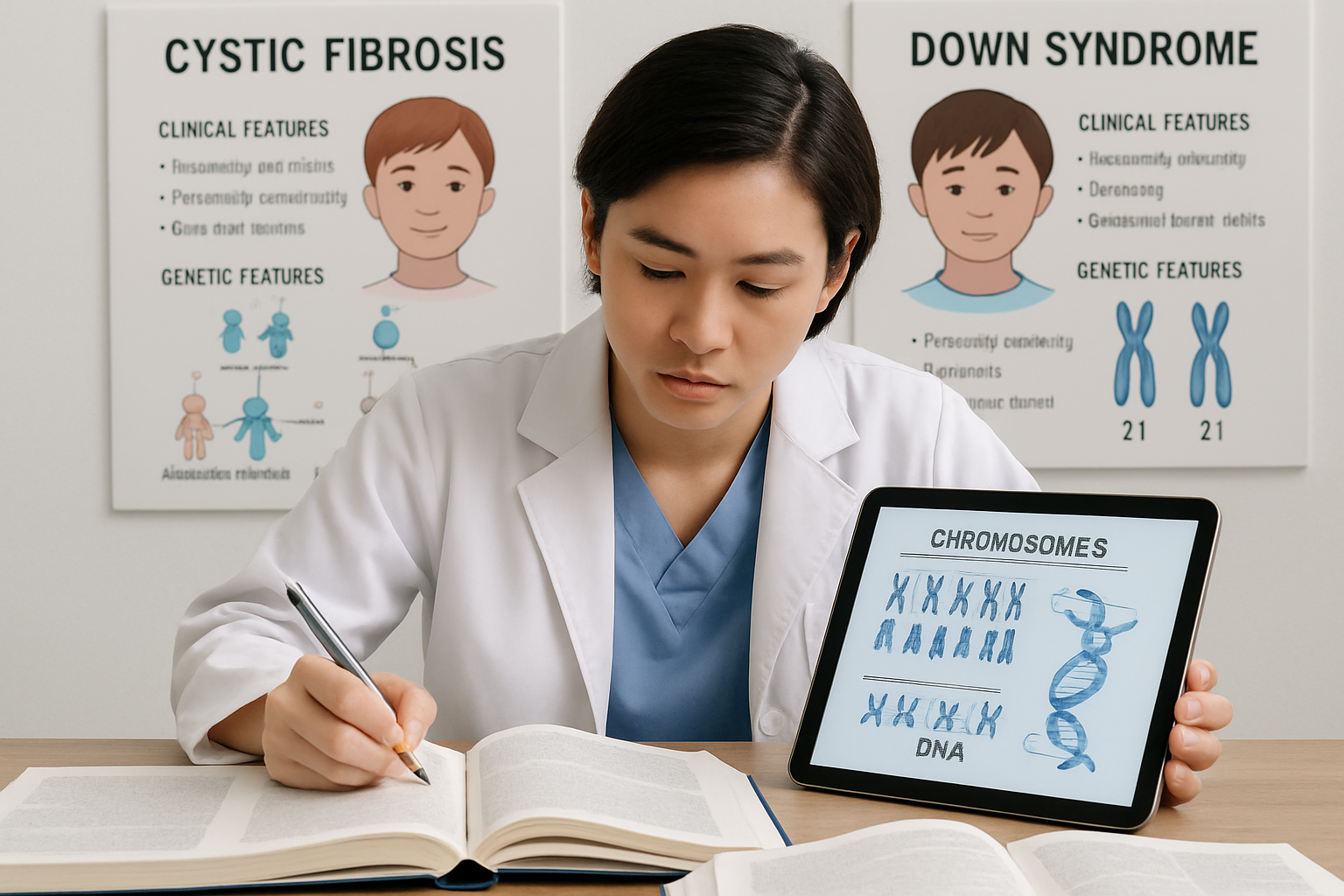
Introduction to Genetic Diseases for PLAB 1 Preparation
Genetic diseases form a significant part of the PLAB 1 syllabus. Understanding these conditions thoroughly is essential, as they frequently appear in clinical questions and scenarios. This article provides a concise yet comprehensive review of common genetic diseases, key inheritance patterns, clinical features, diagnostic clues, and management essentials. Memorizing these points will aid in quick recall during exam conditions.
PLAB 1 exams test your understanding of fundamental medical concepts, including genetic disorders that affect patient care across all specialties. Building a strong knowledge foundation on these conditions ensures you confidently approach related multiple-choice questions, clinical vignettes, and scenario-based inquiries. This guide is tailored specifically for PLAB 1 candidates aiming to maximize efficiency and accuracy in exam preparation.
1. Cystic Fibrosis (CF)
Inheritance: Autosomal recessive
Cause: Mutation in the CFTR gene leading to defective chloride channels
Clinical Features: Chronic pulmonary infections, pancreatic insufficiency, meconium ileus in newborns, salty-tasting skin, male infertility due to absence of vas deferens
Diagnosis: Sweat chloride test (gold standard), genetic testing for CFTR mutations
Management: Airway clearance, antibiotics, pancreatic enzyme supplementation, nutritional support, lung transplantation in severe cases
Additional Notes: Keep in mind that CF causes thick mucus secretions affecting multiple organs. Chronic lung infections with organisms like Pseudomonas aeruginosa predominate. Pancreatic insufficiency leads to fat malabsorption and fat-soluble vitamin deficiencies (A, D, E, K). Regular chest physiotherapy is critical to manage sputum clearance. Early diagnosis and multidisciplinary care significantly improve patient outcomes.
Key Point: Remember CF presents with multi-system involvement – lung, pancreas, GI tract, and reproductive system.
2. Down Syndrome (Trisomy 21)
Inheritance: Usually random trisomy, can be translocation (familial)
Cause: Extra copy of chromosome 21
Clinical Features: Intellectual disability, characteristic facial features (flat nasal bridge, epicanthic folds, upslanting palpebral fissures), single palmar crease, hypotonia, congenital heart defects (AV septal defect), increased risk of leukemia and early Alzheimer’s disease
Diagnosis: Prenatal screening (ultrasound, serum markers), karyotyping at birth
Management: Supportive care, early intervention programs, cardiac surgery if needed
Additional Notes: Associated conditions include duodenal atresia, Hirschsprung disease, hypothyroidism, and hearing loss. Lifespan has improved with medical advances, but patients require multidisciplinary care, including educational and social support. Prenatal diagnosis is possible via chorionic villus sampling and amniocentesis. Genetic counseling also plays a vital role for affected families.
Key Point: Increased risk of duodenal atresia and Hirschsprung disease should be considered.
3. Sickle Cell Disease
Inheritance: Autosomal recessive
Cause: Mutation in beta-globin gene producing hemoglobin S
Clinical Features: Vaso-occlusive crises causing pain, chronic hemolytic anemia, susceptibility to infections, dactylitis in children, stroke risk, splenic sequestration
Diagnosis: Hb electrophoresis confirms presence of HbS
Management: Pain control, hydroxyurea to increase HbF, prophylactic antibiotics and vaccinations, blood transfusions for severe anemia, bone marrow transplant in selected cases
Additional Notes: Know that triggers for sickling include hypoxia, dehydration, infection, and cold exposure. Acute chest syndrome is a life-threatening complication. Patients often develop autosplenectomy by adulthood, increasing infection risk, especially from encapsulated bacteria. Routine vaccinations against pneumococcus, meningococcus, and Haemophilus influenzae are essential. Regular monitoring and patient education are crucial for crisis prevention.
Key Point: Remember triggers for sickling: hypoxia, dehydration, infection, cold exposure.
4. Duchenne Muscular Dystrophy (DMD)
Inheritance: X-linked recessive
Cause: Mutation in dystrophin gene
Clinical Features: Progressive muscle weakness starting in early childhood, calf pseudohypertrophy, Gowers’ sign, cardiomyopathy
Diagnosis: Elevated serum creatine kinase, genetic testing, muscle biopsy
Management: Physical therapy, corticosteroids to slow progression, cardiac monitoring, respiratory support
Additional Notes: Becker muscular dystrophy presents later and is less severe due to partially functional dystrophin. Early cardiac and respiratory complications lead to morbidity and mortality; ongoing surveillance is vital. Genetic counseling is important for affected families. Newer therapeutic approaches like gene therapy and exon skipping are currently under research and show promise for the future.
Key Point: DMD presents predominantly in boys; Becker muscular dystrophy is a milder allelic variant.
5. Huntington’s Disease
Inheritance: Autosomal dominant
Cause: CAG trinucleotide repeat expansion in HTT gene
Clinical Features: Adult onset chorea, cognitive decline, psychiatric symptoms
Diagnosis: Genetic testing for CAG repeats
Management: Symptomatic treatment with antipsychotics, benzodiazepines, physical therapy
Additional Notes: The number of CAG repeats correlates with disease severity and age of onset; larger expansions result in earlier symptoms. Psychiatric manifestations may precede motor symptoms. Genetic counseling is imperative due to autosomal dominant inheritance. No cure exists; focus is on improving quality of life and supportive therapies.
Key Point: Anticipation phenomenon seen; earlier onset in successive generations.
6. Marfan Syndrome
Inheritance: Autosomal dominant
Cause: Mutation in fibrillin-1 gene
Clinical Features: Tall stature, arachnodactyly, lens dislocation (upward), aortic root dilation and aneurysm, mitral valve prolapse, pectus excavatum
Diagnosis: Clinical criteria (Ghent), genetic testing
Management: Beta-blockers to reduce aortic stress, regular cardiac monitoring, surgical repair of aortic aneurysm
Additional Notes: Skeletal features include scoliosis and hypermobile joints. Early diagnosis is essential to prevent fatal aortic complications. Pregnant women with Marfan syndrome require close monitoring due to increased cardiovascular risk. Avoidance of strenuous activities and contact sports is advised to minimize aortic stress.
Key Point: Cardiovascular complications cause most morbidity and mortality.
7. Tay-Sachs Disease
Inheritance: Autosomal recessive
Cause: Deficiency of hexosaminidase A enzyme leading to GM2 ganglioside accumulation
Clinical Features: Progressive neurodegeneration in infants, developmental delay, cherry-red spot on macula, exaggerated startle response
Diagnosis: Enzyme assay, genetic testing
Management: Supportive care only
Additional Notes: Common in Ashkenazi Jewish populations, with carrier screening highly recommended. The disease leads to death in early childhood. No curative treatment is available; supportive interventions focus on symptom management. Prenatal diagnosis is possible via enzyme analysis or genetic testing on chorionic villus samples. Counseling families about recurrence risks is important.
Key Point: Consider in Ashkenazi Jewish descent or other high-risk populations.
8. Additional Genetic Diseases to Know for PLAB 1
Beyond the major genetic disorders above, some additional diseases frequently appear in clinical discussions or differential diagnoses on PLAB 1:
Phenylketonuria (PKU)
Inheritance: Autosomal recessive
Cause: Deficiency of phenylalanine hydroxylase enzyme leading to phenylalanine accumulation
Clinical Features: Intellectual disability, seizures, fair skin, eczema, musty body odor
Diagnosis: Newborn screening via blood phenylalanine levels
Management: Dietary restriction of phenylalanine to prevent neurological damage; early intervention is critical to prevent irreversible cognitive impairment.
Hemophilia A and B
Inheritance: X-linked recessive
Cause: Deficiency of clotting factor VIII (Hemophilia A) or IX (Hemophilia B)
Clinical Features: Easy bruising, prolonged bleeding, hemarthroses
Diagnosis: Prolonged activated partial thromboplastin time (aPTT), factor assays
Management: Replacement therapy with clotting factors, bleeding precautions, and patient education about injury avoidance are essential.
Fragile X Syndrome
Inheritance: X-linked dominant with anticipation
Cause: CGG trinucleotide repeat expansion in FMR1 gene
Clinical Features: Intellectual disability, large ears, macroorchidism, autistic features
Diagnosis: Genetic testing for CGG repeats
Management: Supportive therapies, educational interventions, and behavioral support are necessary for improving function.
General Recommendations for PLAB 1 Preparation
- Focus on inheritance patterns: Knowing whether a disease is autosomal dominant, autosomal recessive, or X-linked is crucial for exam questions.
- Memorize key clinical features: These are often tested as distinguishing factors.
- Understand common diagnostic tools: For example, sweat test for CF, Hb electrophoresis for sickle cell disease.
- Be aware of management basics: Although detailed treatment is less emphasized, knowing fundamental management steps is important.
- Practice clinical vignettes: Applying this knowledge to patient scenarios helps retention and exam readiness.
- Utilize mnemonics and tables: Group diseases by inheritance or systems affected to make memorization easier.
- Stay updated on guidelines: Be aware that some management protocols evolve with new evidence.
Common Mistakes and How to Avoid Them
- Confusing inheritance patterns – create flashcards to reinforce these.
- Mixing clinical features from similar diseases – use comparison tables for diseases like Duchenne vs Becker muscular dystrophy.
- Neglecting the systemic nature of some diseases (e.g., CF, Marfan syndrome) – review multi-organ involvement carefully.
- Forgetting population risk factors – some diseases like Tay-Sachs are more frequent in specific ethnic groups.
- Overlooking complication risks – such as aortic aneurysm rupture in Marfan or stroke in sickle cell disease.
Summary Table: Quick Recall Guide
| Disease | Inheritance | Key Features | Diagnostic Test |
|---|---|---|---|
| Cystic Fibrosis | Autosomal recessive | Lung infections, pancreatic insufficiency | Sweat chloride test |
| Down Syndrome | Trisomy 21 (usually random) | Characteristic facial features, heart defects | Karyotype |
| Sickle Cell | Autosomal recessive | Hemolytic anemia, vaso-occlusive crises | Hb electrophoresis |
| Duchenne Muscular Dystrophy | X-linked recessive | Progressive muscle weakness, pseudohypertrophy | CK levels, genetic testing |
| Huntington’s Disease | Autosomal dominant | Chorea, cognitive decline | Genetic testing for CAG repeats |
| Marfan Syndrome | Autosomal dominant | Tall, lens dislocation, aortic aneurysm | Genetic testing, clinical criteria |
| Tay-Sachs Disease | Autosomal recessive | Neurodegeneration, cherry-red spot | Enzyme assay |
| Phenylketonuria (PKU) | Autosomal recessive | Intellectual disability, musty odor | Newborn screening |
| Hemophilia A & B | X-linked recessive | Bleeding, hemarthroses | Factor assay, aPTT |
| Fragile X Syndrome | X-linked dominant | ID, macroorchidism | Genetic testing |
Final Tips for Exam Success
Consistency in revision, application of knowledge to clinical cases, and active recall methods such as flashcards and quizzes will significantly improve retention of genetic disease topics. Focus also on understanding inheritance patterns deeply as this is a recurring theme in many PLAB questions. Ensuring you can distinguish closely related diseases by their defining clinical and genetic features will give you an advantage.
Practice answering exam-style questions with clinical vignettes involving genetic diseases. This approach improves your skills in applying theoretical knowledge under time constraints. Finally, keep abreast of any updated PLAB guidelines or recommended reading to align your preparation with the current examination framework. Stay disciplined, and your efforts will be rewarded with success.
Frequently Asked Questions (FAQs)
- Q: What inheritance pattern does cystic fibrosis have?
A: Cystic fibrosis is inherited in an autosomal recessive pattern. - Q: Which genetic disease is associated with a ‘cherry-red spot’ on the macula?
A: Tay-Sachs disease is characterized by a cherry-red spot on the macula. - Q: What is the common cause of death in Marfan syndrome?
A: Cardiovascular complications, especially aortic aneurysm rupture, are the leading cause of death. - Q: How is sickle cell disease diagnosed?
A: It is diagnosed using hemoglobin electrophoresis which detects the presence of hemoglobin S. - Q: What distinguishes Duchenne from Becker muscular dystrophy?
A: Both are X-linked recessive, but Duchenne presents earlier and is more severe due to absent dystrophin, whereas Becker is milder with partially functional dystrophin.
