

Introduction
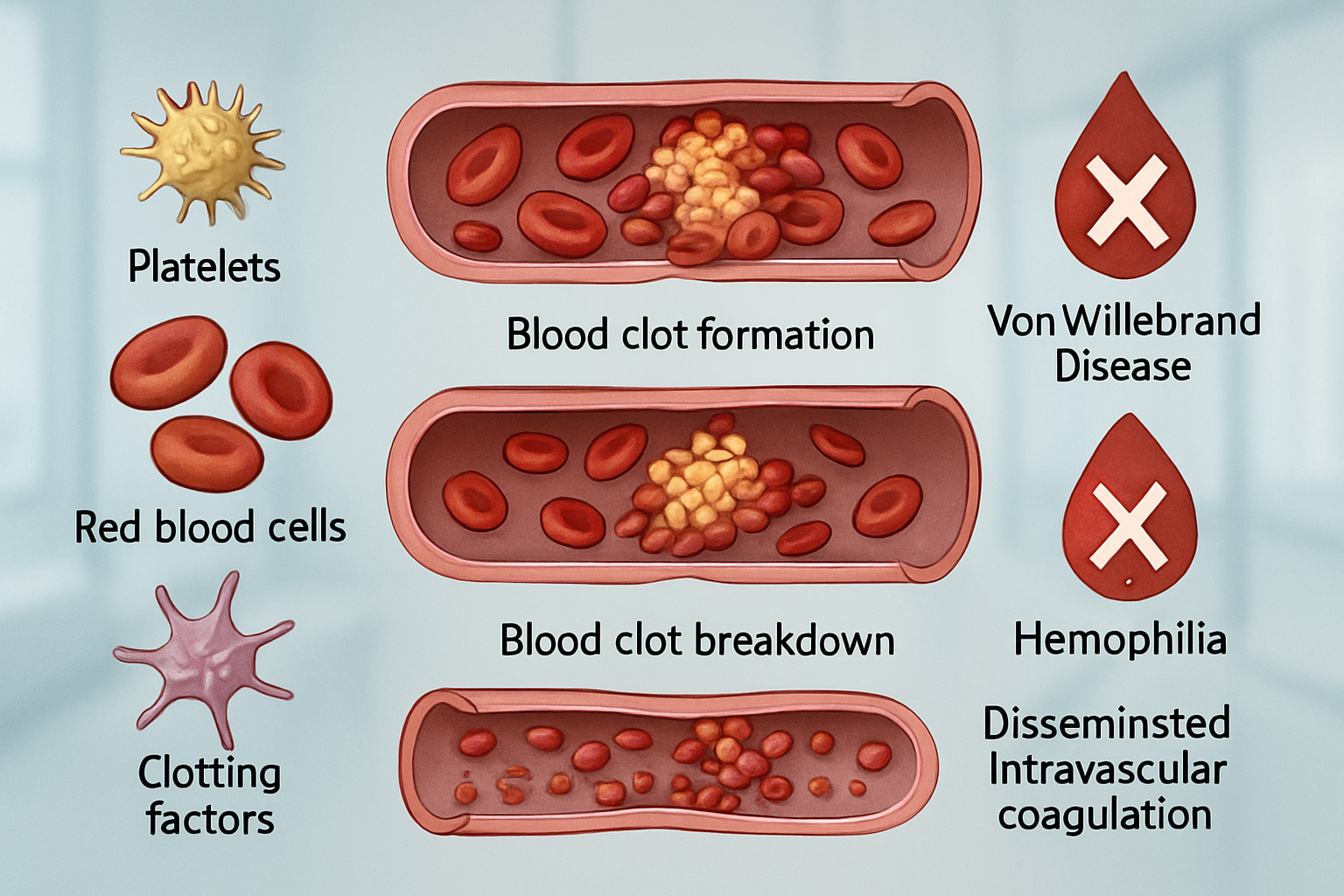
For medical professionals preparing for the Professional and Linguistic Assessments Board (PLAB) exams, a clear understanding of bleeding disorders is essential. Von Willebrand Disease (VWD), Hemophilia, and Disseminated Intravascular Coagulation (DIC) are critical conditions that frequently appear in exam scenarios. This detailed comparison focuses on their pathophysiology, clinical presentation, laboratory findings, and management strategies to facilitate high-yield learning and effective recall.
Bleeding disorders represent a significant challenge both in clinical practice and examinations due to their varied etiologies, presentations, and complexities in management. A thorough comprehension of these three conditions will aid in accurate diagnosis and prompt treatment, which are crucial for preventing morbidity and mortality. Furthermore, these disorders integrate essential concepts in hematology that reflect on broader principles necessary for success in the PLAB exams.
Pathophysiology: Understanding the Basics
Von Willebrand Disease (VWD) is the most common inherited bleeding disorder, caused by quantitative or qualitative defects in von Willebrand factor (vWF), a large multimeric glycoprotein. vWF plays a dual role by mediating platelet adhesion to the subendothelium at sites of vascular injury and serving as a carrier protein that stabilizes clotting factor VIII in circulation. The deficiency or dysfunction leads to impaired primary hemostasis and secondary coagulation cascade involvement.
Hemophilia primarily consists of two inherited disorders: Hemophilia A, resulting from factor VIII deficiency, and Hemophilia B (Christmas disease) from factor IX deficiency. Both factors are integral components of the intrinsic pathway of the coagulation cascade, and their absence results in ineffective thrombin generation and impaired fibrin clot formation. Hemophilia follows an X-linked recessive inheritance pattern, predominantly affecting males.
Disseminated Intravascular Coagulation (DIC) is an acquired disorder characterized by systemic, pathologic activation of coagulation pathways, often triggered by infections, malignancies, trauma, or obstetric complications. This uncontrolled thrombin generation causes widespread fibrin deposition in microvasculature leading to organ ischemia, while simultaneous consumption of clotting factors and platelets precipitates severe bleeding. The balance between coagulation and fibrinolysis is profoundly disturbed, which contributes to its clinical complexity.
Clinical Presentation: Differentiating Features
Although bleeding is a shared hallmark, these conditions exhibit distinct clinical manifestations critical for differential diagnosis:
- VWD: Patients typically exhibit mucocutaneous bleeding — such as frequent nosebleeds (epistaxis), heavy menstrual bleeding (menorrhagia), easy bruising, and prolonged oozing from minor lacerations or after dental procedures. Gastrointestinal bleeding may be evident in severe subtypes. The bleeding is usually mild to moderate and may worsen during trauma or surgery.
- Hemophilia: Presents predominantly with deep tissue bleeding, including spontaneous hemarthroses (bleeding into joints) leading to joint swelling, pain, and long-term arthropathy. Muscle hematomas causing compartment syndrome and intracranial hemorrhages are serious complications. Bleeding episodes are often severe and may occur without obvious trauma.
- DIC: Characterized by both bleeding and thrombosis simultaneously. Patients can have oozing from intravenous catheter sites, mucosal hemorrhages, petechiae, and ecchymoses. Thrombotic manifestations include microvascular occlusions causing acute kidney injury, respiratory distress, or neurologic deficits. The clinical context usually involves a critically ill patient with underlying disease precipitating DIC.
Laboratory Findings: Key Diagnostic Points
A systematic approach to laboratory investigations assists in differentiating these disorders:
| Test | Von Willebrand Disease | Hemophilia | Disseminated Intravascular Coagulation |
|---|---|---|---|
| Platelet Count | Normal | Normal | Low (thrombocytopenia) |
| PT (Prothrombin Time) | Normal | Normal | Prolonged |
| aPTT (Activated Partial Thromboplastin Time) | Prolonged or Normal (depending on subtype) | Prolonged | Prolonged |
| Bleeding Time | Prolonged | Normal | Prolonged |
| Factor VIII Levels | Decreased (variable) | Decreased (Hemophilia A) | Decreased |
| Factor IX Levels | Normal | Decreased (Hemophilia B) | Decreased |
| Fibrinogen | Normal | Normal | Decreased |
| D-dimer | Normal | Normal | Elevated |
Additional Diagnostic Tests:
- Ristocetin cofactor assay: Specifically measures vWF activity, critical in diagnosing VWD.
- vWF antigen levels: Determine quantitative deficiency.
- Mixing studies: Used in prolonged aPTT cases to differentiate factor deficiencies from inhibitors.
- Peripheral blood smear: May show schistocytes in DIC due to microangiopathic hemolytic anemia.
Management Strategies: Treatment and Considerations
Von Willebrand Disease: Treatment is dictated by disease subtype and severity. Desmopressin (DDAVP) is effective in many cases of type 1 and some type 2 VWD by stimulating release of stored vWF and factor VIII from endothelial cells. In severe cases, especially type 3, replacement therapy with plasma-derived vWF concentrates is necessary. Adjunctive therapy includes antifibrinolytics such as tranexamic acid to control mucosal bleeding and hormonal therapy for menorrhagia.
Hemophilia: The cornerstone of management is factor replacement therapy. Factor VIII concentrates are administered in Hemophilia A, while factor IX concentrates are used for Hemophilia B. Prophylactic infusions to prevent bleeding episodes, especially joint bleeds, are standard in severe cases. Immune tolerance induction is an important strategy when patients develop inhibitors (antibodies) against infused factors. Emerging therapies include gene therapy and novel non-factor agents, although these may not currently be prominent in the PLAB curriculum.
DIC: Management is primarily supportive and focused on treating the underlying precipitant, such as antibiotics for sepsis or surgical intervention in trauma. Blood product transfusions with fresh frozen plasma replenish consumed clotting factors; platelet transfusions address thrombocytopenia when counts are critically low or active bleeding is present. Sometimes low-dose heparin therapy helps inhibit ongoing thrombosis but requires meticulous balancing to avoid exacerbating bleeding. Close monitoring in intensive care settings is often required.
Common Mistakes and Pitfalls in Exam Contexts
- Misinterpreting laboratory investigations: For example, assuming all prolonged aPTT indicates hemophilia when VWD or even lupus anticoagulant can cause similar results.
- Overlapping symptoms: Although bleeding types differ among disorders, clinical overlap can challenge diagnosis without proper lab correlation.
- Ignoring inheritance patterns: Remember that VWD is mostly autosomal dominant and thus affects males and females equally, whereas hemophilia is X-linked and predominantly affects males.
- Underestimating the clinical urgency of DIC: Recognizing the acute nature and identifying triggers saves lives.
- Miscalculating factor replacement dosage and timing: Understanding half-lives and pharmacodynamics is crucial for effective management, particularly in hemophilia.
Practical Learning Tips for PLAB Exams
- Create comparison tables to memorize differences effectively.
- Use clinical vignettes to recognize bleeding patterns and correlate with lab results.
- Practice interpreting coagulation profiles in diverse scenarios to build analytical skills.
- Memorize treatment options along with indications, contraindications, and complications.
- Employ mnemonic devices such as “VWD affects (V)ascular (W)alls and Platelets,” or “Hemophilia: H for Hemarthrosis, inherited on the X chromosome” to aid retention.
- Review case studies involving DIC to understand the significance of underlying disease management.
Summary Table: Key Differences at a Glance
| Feature | Von Willebrand Disease | Hemophilia | DIC |
|---|---|---|---|
| Inheritance | Autosomal dominant | X-linked recessive | Acquired |
| Bleeding Type | Mucocutaneous | Deep tissue (joints, muscles) | Both bleeding and thrombosis |
| Platelet Count | Normal | Normal | Decreased |
| Coagulation Studies | Variable aPTT, prolonged bleeding time | Prolonged aPTT, normal bleeding time | Prolonged PT, aPTT, low fibrinogen |
| Treatment | DDAVP, vWF concentrates | Factor replacement | Address cause, replace factors, supportive care |
Additional Clinical Pearls
- Von Willebrand Disease Subtypes: Type 1 is a partial quantitative deficiency; Type 2 includes qualitative defects subdivided into different variants; and Type 3 involves virtually complete absence of vWF and is the rarest and most severe.
- Hemophilia Severity Classification: Based on factor activity levels — severe (<1% activity), moderate (1-5%), and mild (>5%). Severity correlates with bleeding frequency and clinical manifestations.
- DIC Scoring Systems: The International Society on Thrombosis and Haemostasis (ISTH) scoring system helps in diagnosis and monitoring by integrating platelet count, fibrin-related markers, PT, and fibrinogen levels.
- Role of Platelets: In VWD, platelets cannot adhere properly without functioning vWF, whereas platelet numbers remain normal. In DIC, platelets are consumed due to widespread clotting, leading to thrombocytopenia.
- Importance of History: Family history of bleeding favors inherited disorders like VWD and hemophilia, whereas DIC typically occurs acutely with no hereditary pattern.
Conclusion
Mastering the distinctions between Von Willebrand Disease, Hemophilia, and DIC is essential for success in the PLAB exams. This high-yield comparison highlights clinical features, diagnostic clues, and management principles that enhance knowledge retention and clinical reasoning. The integration of pathophysiology, clinical presentation, laboratory findings, and treatment considerations provides a comprehensive framework to approach these complex disorders confidently. Focused study on these aspects will not only improve exam performance but also contribute to better clinical practice and improved patient outcomes worldwide.
