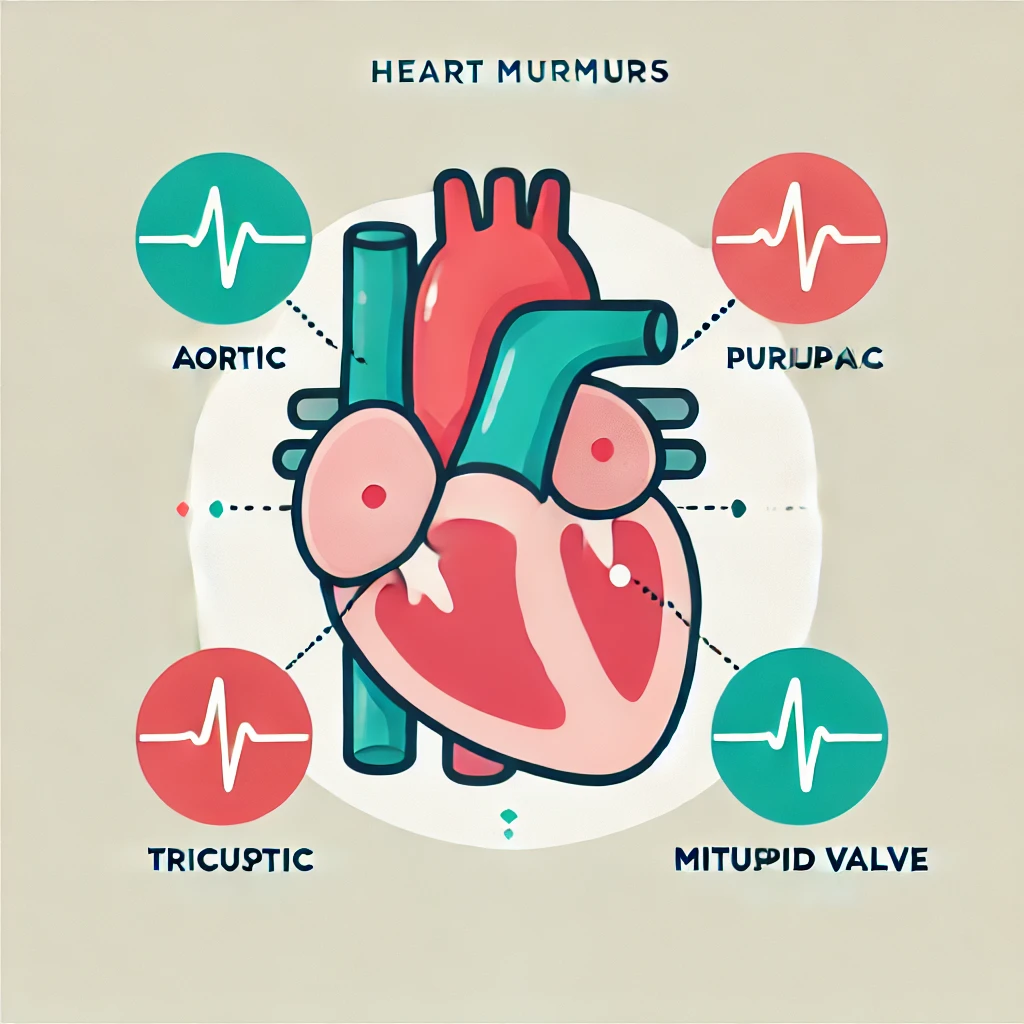
A heart murmur is an abnormal sound heard during the cardiac cycle due to turbulent blood flow. It may be innocent (physiological) or indicate underlying valvular or structural heart disease. Proper assessment of murmurs requires understanding timing, location, radiation, pitch, and maneuvers.
2. Classification of Heart Murmurs
Heart murmurs are classified based on timing in the cardiac cycle and clinical characteristics.
(A) Based on Timing
| Type |
Occurs During |
Common Causes |
| Systolic Murmurs |
Between S1 and S2 |
Aortic stenosis, mitral regurgitation, VSD |
| Diastolic Murmurs |
Between S2 and S1 |
Aortic regurgitation, mitral stenosis |
| Continuous Murmurs |
Throughout systole & diastole |
Patent ductus arteriosus (PDA) |
(B) Based on Intensity (Grading)
| Grade |
Description |
| Grade 1 |
Barely audible |
| Grade 2 |
Soft, but easily heard |
| Grade 3 |
Loud, no thrill |
| Grade 4 |
Loud with a palpable thrill |
| Grade 5 |
Heard with stethoscope partially off the chest |
| Grade 6 |
Heard without a stethoscope |
3. Classification of Heart Murmurs by Defect, Type, and Location
| Defect |
Murmur Type |
Location |
Radiation |
Maneuvers & Key Features |
| Aortic Stenosis (AS) |
Ejection systolic murmur (crescendo-decrescendo) |
Right upper sternal border |
Carotids |
Louder with squatting, softer with Valsalva |
| Mitral Regurgitation (MR) |
Pansystolic (holosystolic) murmur |
Apex |
Axilla |
Louder with handgrip, softer with Valsalva |
| Pulmonary Stenosis (PS) |
Ejection systolic murmur (crescendo-decrescendo) |
Left upper sternal border |
None |
Increases with inspiration |
| Tricuspid Regurgitation (TR) |
Pansystolic (holosystolic) murmur |
Left lower sternal border |
None |
Increases with inspiration (Carvallo’s sign) |
| Ventricular Septal Defect (VSD) |
Pansystolic (holosystolic) murmur |
Left lower sternal border |
None |
Louder with handgrip, harsh sound |
| Aortic Regurgitation (AR) |
Early diastolic murmur (decrescendo) |
Left sternal border |
None |
Louder with handgrip, softer with Valsalva |
| Mitral Stenosis (MS) |
Mid-diastolic murmur (low-pitched, rumbling) |
Apex |
None |
Louder with exercise, best heard with bell of stethoscope |
| Tricuspid Stenosis (TS) |
Mid-diastolic murmur |
Left lower sternal border |
None |
Louder with inspiration |
| Patent Ductus Arteriosus (PDA) |
Continuous “machine-like” murmur |
Left infraclavicular area |
None |
Does not change with respiration |
4. Clinical Approach to Heart Murmurs
(A) History and Symptoms
- Asymptomatic vs. Symptomatic: Innocent murmurs often lack symptoms.
- Dyspnea, chest pain, syncope: Suggests severe valvular disease.
- Palpitations, heart failure symptoms: Associated with mitral/aortic disease.
(B) Physical Examination
- Palpate for thrills (grade ≥4 murmurs).
- Listen for murmur location, radiation, pitch, and response to maneuvers.
(C) Diagnostic Workup
| Test |
Purpose |
| ECG |
Check for LVH, arrhythmias |
| Echocardiography (TTE/TEE) |
Gold standard for valve assessment |
| Chest X-ray |
Look for cardiomegaly, pulmonary congestion |
| Cardiac MRI |
Advanced imaging for complex valve pathology |
| Cardiac Catheterization |
Assess hemodynamics before surgery |
5. Management of Common Murmurs
(A) Medical Therapy
| Condition |
First-Line Management |
| Aortic Stenosis |
BP control, avoid excessive preload reduction |
| Mitral Regurgitation |
ACE inhibitors, diuretics |
| Aortic Regurgitation |
Vasodilators (e.g., nifedipine), ACE inhibitors |
| Mitral Stenosis |
Diuretics, beta-blockers |
(B) Surgical & Interventional Management
| Condition |
Indication for Surgery |
| Aortic Stenosis |
Symptomatic, severe AS |
| Mitral Regurgitation |
EF <60%, symptomatic patients |
| Aortic Regurgitation |
Severe regurgitation with symptoms |
| Mitral Stenosis |
Symptomatic with severe MS (valvuloplasty) |
6. Key Takeaways
✅ Systolic murmurs are more common; diastolic murmurs are always pathological.
✅ AS radiates to the carotids, MR radiates to the axilla.
✅ Handgrip increases regurgitant murmurs; Valsalva decreases most murmurs except HOCM and MVP.
✅ Echocardiography is the gold standard for murmur assessment.
✅ Definitive treatment often involves valve repair or replacement.
Further Reading
- NHS Overview of Heart Murmurs: NHS UK
- European Society of Cardiology (ESC) Guidelines on Valvular Disease: ESC Guidelines